

I confess I have a bias against literary fiction that is almost entirely based on the perception of the genre as the best. My experience of literary fiction has largely been one defined by a very specific point of view that is, by nature, exclusionary. When I think of works of literature I think about boring topics (often white people discovering things), spare prose and lack of a driving plot. A lot of this is informed by what was presented to me in school by professors or by snooty fellow author aspirants who see literature as a way to distinguish themselves as smarter or better than. I don’t think my opinion is necessarily correct, after all, I can be a hating-ass bitch. It’s also possible I’m projecting my own insecurities about the things I love and the kind of art I can make.
Anyways, as I wrote a few weeks ago, I decided to read a Pulitzer prize winning work in an attempt to prevent my brain from rotting out of my skull due to mobile game induced psychosis. And you know, I think it worked.
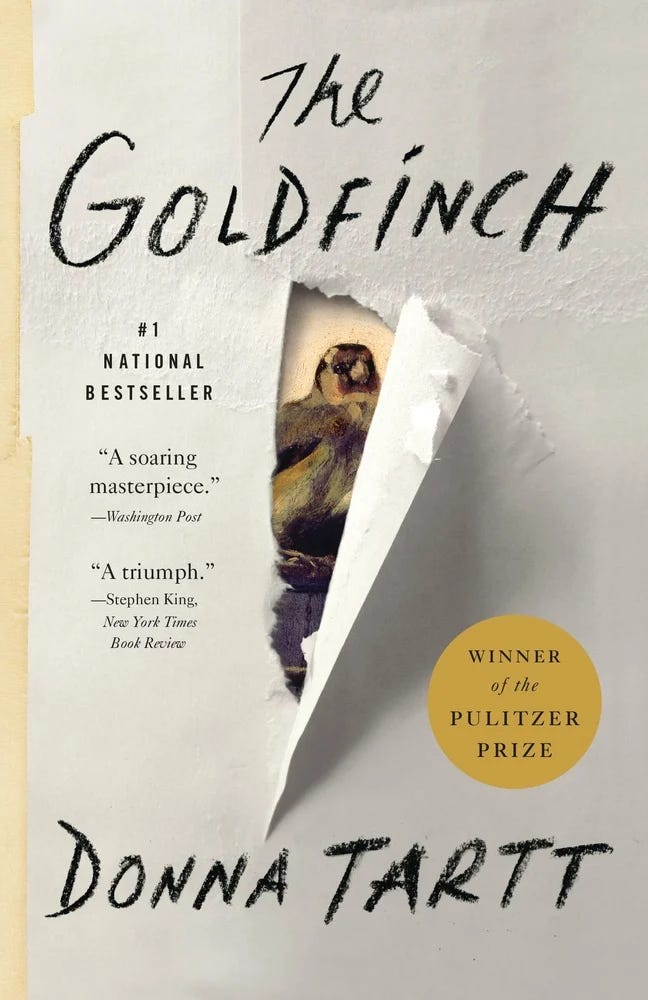
The Goldfinch, by Donna Tartt 🎧
Genre: Literary fiction
What’s it about: Theo Decker is the 13-year-old son of a beautiful and charming mother and a dirtbag father who has abandoned them both. One fateful day, his mother takes him to the Metropolitan Museum of Art, and he ends up as one of few survivors of a terrorist attack that claims the life of his mother. The rest of the novel spans about ten years of Theo’s life and the aftermath of the attack - and the titular work of art - that changed his life forever.
Was it good? Yes! I’m kind of embarrassed because I was obsessed with the idea of the literary brat pack (this article about them is great) as a teen but at the time I was most drawn to Brett Eaton Ellis, a fact that I won’t reflect on because I fear what this says about me. The Goldfinch was a great listen on audio, and if not for his length, I would’ve stayed up all night to read it because it’s very propulsive, even if it’s meandering. The prose is excellent, it’s super stylish and gives specific details that ground you in the character and make the world feel so natural. Even the literary flourishes, like a description of Theo’s feelings with a reference to Macbeth, come off as relevant and clever even though it could easily be eye-roll worthy. Tartt also writes with great affection for even the worst characters, and it completely drew me in.
Highlights:
I can’t help but love the Barbours, even though they really, really suck. This is due to the quality of Tartt’s writing.
The ending does involve a lot of thematic monologuing, which works for me here, but you may find me criticizing such technique in other works. I’m fickle that way.
I love Boris. He is hot. I too would be kind of in love with him.
The general vibe of the literary brat pack was nihilistic, and Donna Tartt stays in that vein. But, there’s a joyousness here, just as much as there’s a relentless sadness in it. I really connected to the idea that some hearts draw you towards otherness and towards chaos. Life is a game that you always lose, but “you can play it with a kind of joy.”
It took me three months to get through Donna Tartt's "The Goldfinch." I bought a used copy in April, right before I left for Halifax. The harbor in Halifax was the site of a monstrous 1917 gunpowder explosion like the one in Delft that killed the artist, Carel Fabritius (1622-1654). Then I was inspired to get a canvas print to lean on a little floating shelf in my bathroom. It took another 10 days for that to come in. I look at "The Goldfinch" every day when I brush my teeth. But about halfway through, it seemed so logical to go to Amsterdam in June (all of June, actually, but I'm not sure if that was really necessary). Amsterdam is so pretty, but they had a rail strike and I never made it to Hague to see the picture. Now I have to go back in the fall and try again. The book is finished, but my brain is still sorting out the connections. I left the book in the airport for someone else to discover. The world is just one big mind map, full of interesting connections.